
By Kateryna Shymkevych, historian and analyst:
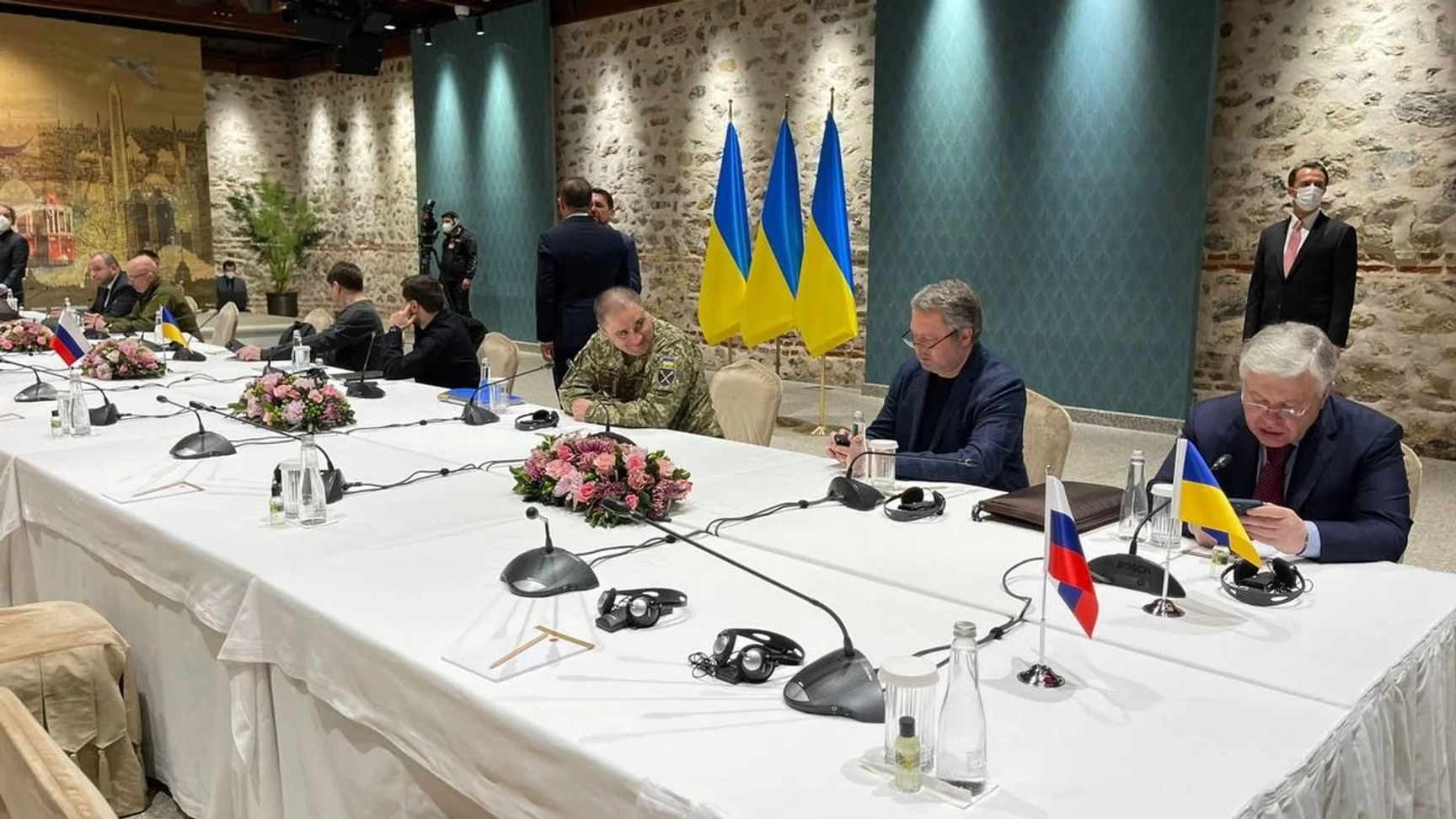
Every now and then, social media posts claim that in March–April 2022, during the peace talks in Istanbul, Ukraine refused to reach a ceasefire agreement with Russia and thereby provoked further escalation. Later, another narrative was added: Ukraine allegedly refused to sign the so-called Istanbul agreements because the then UK Prime Minister Boris Johnson forbade Kyiv to do so.
Fakes like these, which the Kremlin's propaganda and disinformation laboratory constantly develops and refines, do not appear in the media space by chance. But first, let us look at what the Istanbul talks and the Istanbul agreements actually were.
An ultimatum disguised as negotiations
On 10 March 2022, Ukrainian Foreign Minister Dmytro Kuleba and Russian Foreign Minister Sergey Lavrov held a high-level meeting at the Antalya Diplomacy Forum. The mediator was Turkish Foreign Minister Mevlüt Çavuşoğlu. A few weeks later, the official delegations of Ukraine and Russia met, and Ukraine presented its vision of a peace agreement. The meeting ended without result, and the talks continued online until mid-April. Formally, the negotiations were frozen because Moscow rejected Kyiv's proposals and put forward its own instead. These were not constructive proposals but ultimatums.
Ukraine was to become a non-aligned state with neutral status and renounce membership in any military alliance, including NATO. It was also to refuse to host foreign bases, troops or nuclear weapons on its territory, limit the size of its army, give Russian the status of a state language, lift all sanctions against Russia, refrain from investigating war crimes committed by Russians, and ban "Nazism" (the propaganda of which has been prohibited by law in Ukraine since 2015). Moscow wanted to discuss Crimea and Donbas separately, demanding that Ukraine give up any attempt to return the Crimean Peninsula by military means. At the same time, the Kremlin did not object to Ukraine joining the European Union.
There was no talk of any constructive agreement: Russia simply demanded that Ukraine capitulate and forget all the crimes the Russian army had committed on Ukrainian territory since 2014.
The agreement was not concluded because of the ultimatum-like nature of the Russian demands and because mass war crimes committed by Russians in Kyiv Oblast came to light. It was precisely in late March and early April 2022 that the Armed Forces of Ukraine liberated part of Kyiv Oblast, including Bucha, Irpin and Borodianka, and the whole world saw the crimes Russian soldiers had committed there.
The fake about Boris Johnson's pressure
In early April, the then UK Prime Minister Boris Johnson, who supported and continues to support Ukraine, paid an unannounced visit to Kyiv. He called all of the Kremlin's statements against him propaganda and explained that Russia cannot be trusted, just as no peace agreements can be signed with it.
The Russians used Johnson's visit to accuse Ukraine of derailing the talks and to spread disinformation that Kyiv, under Western pressure, was rejecting the Kremlin's peace proposals. This fitted perfectly into the Russian narrative of a war waged by the West against Russia on Ukrainian territory. In this way, Ukraine's agency was called into question, Russian aggression against an independent and sovereign state was pushed aside, and the main idea was reinforced: that Ukraine is merely a Western testing ground for military action against Russia. In this disinformation, Moscow named the EU and NATO as its main adversaries, allegedly because these very blocs are aggressive towards Russia and seek its destruction.
The revival method
One of the main methods of disinformation and propaganda is to revive fakes in order to keep interest in them alive in the information and media environment and to push experts and internet users into discussing them. The goal is simple: to keep the information circulating so that it acquires details that never existed. In the case of the so-called Istanbul agreements, which Ukraine supposedly failed to sign, Russia seeks not only to add new invented details to the fake but also to confuse readers and put psychological pressure on Ukrainians and Europeans.
The narrative that Ukraine refused to sign a peace treaty with Russia in Istanbul has resurfaced on social media in recent days for a reason. Ukraine and Europe are preparing for a winter that may prove quite difficult, above all for Ukrainians, because Russia is systematically destroying Ukrainian energy facilities. Ukrainians already lived through this psychological pressure in the winter of 2025–2026, but the situation now looks much worse because of the extensive damage to energy infrastructure. At the same time, the pressure is aimed at dividing Ukrainian society, so that internal resistance to the government turns into protests and demonstrations. Moscow now has one goal: to force Ukraine to capitulate. Russia saw Donald Trump as a helper in this, since in one of his recent statements he called on Ukraine to hold presidential elections. For Putin, it is extremely important to get rid of the current Ukrainian leadership and deepen political and social chaos inside the country.
The shift to these tactics stems from Russia's inability to defeat Ukraine on the battlefield. In recent months, Moscow has made no gains at the front, so it resorts to terrorising the civilian population, targeted psychological attacks and pressure. To widen the pressure on Ukraine, Moscow is reviving the narrative of the so-called Istanbul agreements, so that both the United States and Europe will press the Ukrainian government and Ukrainians at home and abroad. Under these conditions, Putin may be counting on Ukraine agreeing to any peace plan. In the Kremlin's design, this would prove that Ukraine is not an independent actor and follows all of the West's instructions, and that Russia is not the aggressor but a victim of aggression by the collective West.
It is important to remember that Moscow will resort to old propaganda narratives about Ukraine, the EU and NATO again and again, because it is losing. Dragging out old fakes and using proven tactics adapted to new realities are long-standing methods of Russia, which seeks to dominate the world, terrorise people and get its way by killing civilians and resorting to open aggression and genocidal acts.