
News
Russian drone hits Academy of Sciences in Kyiv: Moscow attacks the city it once learned from


Russians strike at what raised them
On 28 September 2026, during the lunch break, a Russian jet-powered drone struck the building of the Presidium of the National Academy of Sciences of Ukraine at 54 Volodymyrska Street in Kyiv. A fire broke out, engulfing the upper floors, and people escaped through the windows. Two Academy employees were killed and several others were injured. The building, which dates back to the mid-19th century, sustained significant damage. Following the strike, the National Academy of Sciences of Ukraine called on the global academic community not to resume cooperation with Russian scientific institutions.
I analyse Russian propaganda every day, and that is why I see this attack as more than just a war crime. It also has a symbolic dimension. Moscow is striking Kyiv as a centre of knowledge. It is like a pupil setting fire to the school where he learned to read and write. And to understand just how literal this metaphor is, we need to go back a few centuries.
Kyiv before Moscow existed
Let us start with the basics. When Prince Volodymyr baptised Kyivan Rus’ in 988, Kyiv became the centre of the new faith. When Yaroslav the Wise was building St Sophia’s Cathedral and founding a library there, Moscow had not yet appeared even in the chronicles: it is first mentioned only in 1147. The Metropolis of Kyiv was the ecclesiastical heart of the entire East Slavic world, and Ukrainian Kyiv was its spiritual capital. It was precisely this legacy that Moscow would later claim as “its own”, even though it came to it late and second-hand.
When an agreement was concluded in Pereiaslav in 1654 between the Ukrainian hetman Bohdan Khmelnytskyi and the Muscovite tsar, there was not a single institution of higher education in the Tsardom of Muscovy. The first, the Slavic-Greek-Latin Academy, was founded in Moscow only in 1687.

By that time, Ukrainians already had several generations of their own educational tradition behind them. The Ostroh Academy, founded by Prince Vasyl-Kostiantyn Ostrozkyi around 1576, became the first school of a higher type among the Eastern Slavs. It combined Greek, Latin and Slavonic learning and was home to a circle of Ukrainian scholars and polemicists. In 1581 the Ostroh Bible was published there – the first complete printed edition of the Holy Scriptures in Church Slavonic. An interesting detail: it was printed by Ivan Fedorov, who had been forced to leave Moscow and found the conditions for his work in Ukrainian lands. The Moscow Bible of 1663, in turn, was in essence a revised reprint of the Ostroh edition. A telling detail: in its preface, “the people of Rus’” – as the ancestors of Ukrainians and Belarusians called themselves at the time – was replaced with “the all-Russian people”.
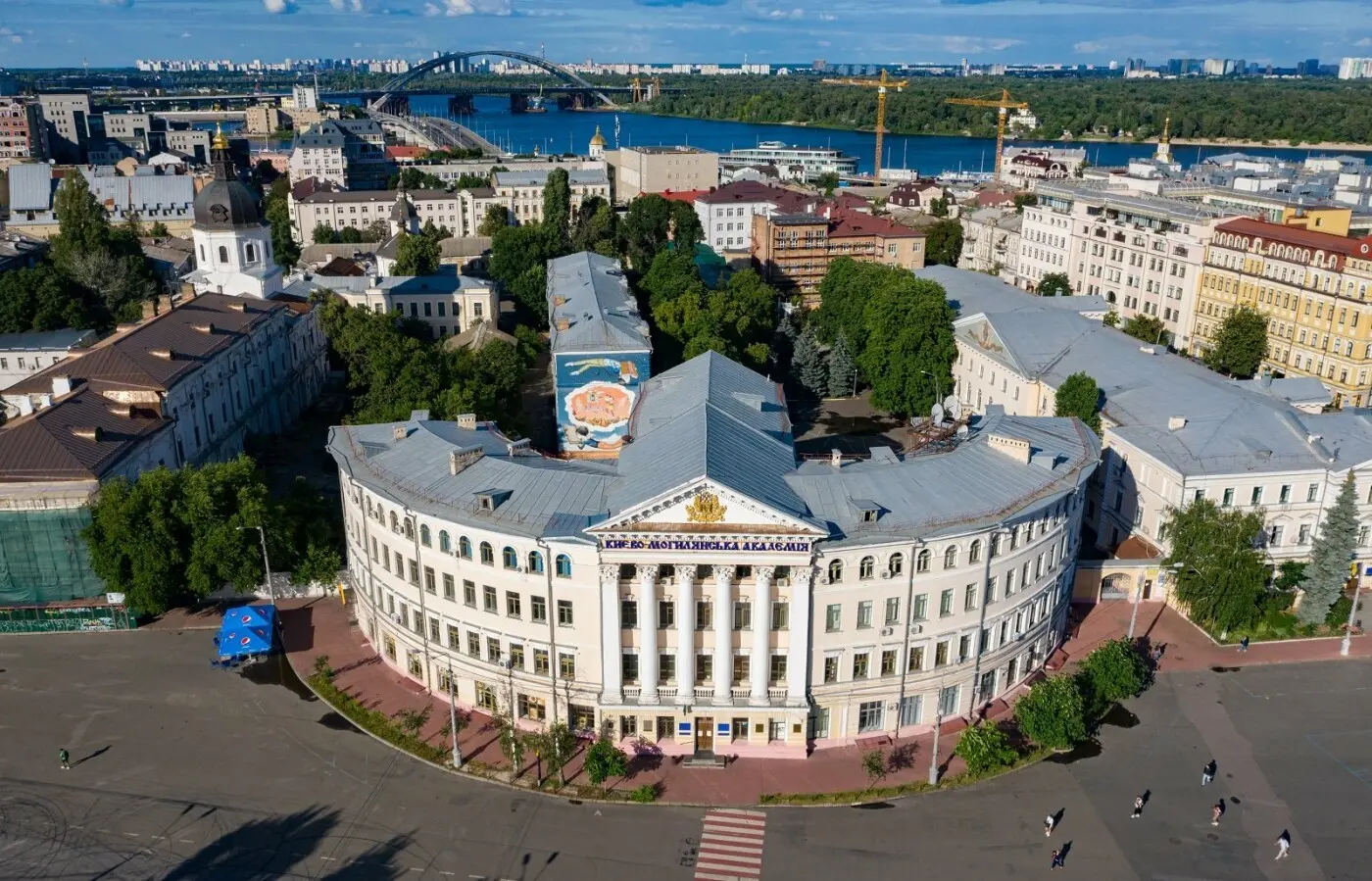
At the same time, brotherhood schools – centres of spiritual life – were springing up in Ukrainian cities: in Lviv, Lutsk and Kyiv. In 1615 a Kyivan woman, Halshka Hulevychivna, donated her estate in Podil for a monastery and a school. This is how the Kyiv Brotherhood School came into being. In 1632 Metropolitan Petro Mohyla of Kyiv merged it with the school of the Kyiv-Pechersk Lavra to form a collegium, later known as the Kyiv-Mohyla Academy.
Latin, Greek, poetics, rhetoric, philosophy and theology were taught here, following the model of the finest European colleges. Students from Ukraine travelled to study in Kraków, Prague, Rome and Leipzig, and returned with knowledge that made Kyiv part of the European intellectual space. Meanwhile, the printing house of the Kyiv-Pechersk Lavra, founded as early as 1615, became one of the most influential in the Orthodox world. In 1701 the collegium officially received the status of an academy, and in the mid-18th century more than a thousand students studied there, not only from Ukraine but also from other Orthodox lands.
It was precisely this Ukrainian experience that Moscow later began to import, having none of its own at the time.
How Kyiv taught Moscow
As early as 1649, learned monks from Kyiv, led by Yepifanii Slavynetskyi, an alumnus of the Kyiv Brotherhood School, were invited to Moscow. Ukrainian scholars translated books, corrected liturgical texts, taught, and became the intellectual backbone of Patriarch Nikon’s church reforms. Those very reforms, which split the Muscovite Church and gave rise to the Old Believers, essentially brought Moscow’s practice into line with Kyivan and Greek models.
Simeon of Polotsk, an alumnus of the Kyiv-Mohyla Collegium and a native of Polotsk in Belarus, became tutor to the tsar’s children. He established syllabic poetry in Moscow and wrote plays for the court theatre. In other words, even where the teacher was not Ukrainian by origin, the school was Ukrainian – the school of Kyiv.
This influence reached its peak in the reign of Peter I. The tsar who wanted to “open a window on Europe” found educated people for the church and schools primarily in Ukraine. Stefan Yavorskyi, a Ukrainian from Galicia and an alumnus of the Mohyla Academy, headed the Russian Church as locum tenens of the patriarchal throne and later became the first president of the Holy Synod. He reorganised the Moscow Slavic-Greek-Latin Academy on the Kyivan model, introduced Latin as the language of instruction and invited teachers from Kyiv.
Feofan Prokopovych, a native of Kyiv and rector of the Kyiv-Mohyla Academy, became the chief ideologist of Peter’s reforms. He wrote the Spiritual Regulation, the document under which the empire’s church was governed for almost two hundred years, until 1917. The Ukrainian Dymytrii Tuptalo, the son of a Cossack captain (sotnyk) from the Kyiv region, whom the Orthodox Church venerates as St Demetrius of Rostov, became Metropolitan of Rostov. His Chetyi-Minei, a collection of the lives of the saints, was printed by the Kyiv-Pechersk Lavra and became one of the most widely read books in the entire empire. It was this very collection that the Serbian theologian St Justin of Ćelije (Popović) largely translated for his Lives of the Saints, which Serbian believers still read today.
This is not a patriotic exaggeration on my part. Kostiantyn Kharlampovych, a historian at Kazan University, showed in his seminal work The Little Russian Influence on Great Russian Church Life, published in Kazan in 1914, that between 1700 and 1762 more than half (70 out of 127) of the bishops of the Russian Church came from Ukraine and Belarus. Seminaries throughout the empire were organised on the Mohyla model – with the same curriculum, the same textbooks and even Latin as the language of instruction – and Ukrainians predominated among their rectors and teachers.
I am always struck by how Russian historiography describes these people. Prokopovych, Yavorskyi and Tuptalo appear in it as “outstanding Russian church figures”. Even when their origins are mentioned, it is only as “Little Russians” – that is, as part of a supposedly single “all-Russian” people – rather than as Ukrainians educated in a Ukrainian school in Ukrainian Kyiv.
Lomonosov’s “gates of learning”
There is another story that everyone who believes in the self-sufficiency of the “Russian world” should know.
In 1619 the Ukrainian scholar Meletii Smotrytskyi published a Grammar of the Church Slavonic language. Moscow reprinted it in 1648, and for more than a century it was from this very Ukrainian book that grammar was taught there. Even Mikhail Lomonosov, the “father of Russian science”, called it, together with Magnitsky’s Arithmetic, “the gates of his learning”.
Lomonosov himself studied at the Slavic-Greek-Latin Academy, which had been reorganised by the Ukrainian Yavorskyi and where Kyiv alumni taught. In 1734, according to a tradition recorded by his biographers, he even spent several months in Kyiv at the Mohyla Academy. In other words, the “father of Russian science” learned grammar from a Ukrainian book, studied at a school built on the Ukrainian model and, according to tradition, even travelled to Ukrainian Kyiv in search of knowledge.
Kyiv and the Balkans
Kyiv’s influence was not limited to Moscow. It was also felt in the Balkans, where Russian propaganda has for years peddled the myth of the “elder brother” and of Moscow as the eternal protector and enlightener of the Slavs. In Serbian media I constantly come across this claim: supposedly, without Russia the Orthodox Slavs would have been left without schools, books or learning of their own. Dates and documents tell a different story.
As early as the 17th century, Metropolitan Petro Mohyla of Kyiv, himself a scion of a family of Moldavian rulers, helped to establish printing in Wallachia and Moldavia. In Iași a school was founded at the Monastery of the Three Holy Hierarchs on the Kyivan model. The Orthodox Confession of Faith, prepared in Kyiv, was approved by the Synod of Iași in 1642 and later recognised by the Eastern patriarchs. In other words, the Orthodox world of south-eastern Europe received from Kyiv not only books but also theological standards.
The first teachers were indeed sent to Sremski Karlovci, the centre of the Serbian Church in the Habsburg Monarchy, from Russia in 1726. But it was Kyiv alumni who founded a European-style Latin school there. In 1733 Manuil Kozachynskyi, a native of Podillia and a graduate of the Kyiv-Mohyla Academy, arrived at the invitation of the Serbian Metropolitan Vikentije Jovanović. He taught at the local Latin school, and in 1734 he wrote Traedokomedia, about the death of the last Serbian tsar, Uroš, which is regarded as the first drama of the modern era in Serbian literature. Other teachers from Kyiv came to Karlovci with him. Kozachynskyi later returned to Kyiv, taught philosophy at his alma mater and became its prefect.
Kozachynskyi’s pupil Jovan Rajić later studied in Kyiv himself, at the Mohyla Academy (1753–1756), wrote the first printed history of the Serbs and became the founder of modern Serbian historiography. His History of Various Slavic Peoples, Especially the Bulgarians, Croats and Serbs laid the foundations of the Serbs’ scholarly view of their own past.
Let us pause for a moment. The Serbs, whom Moscow manipulates most actively today, received their first modern drama and their first printed history thanks to a Ukrainian teacher and the Kyiv-Mohyla Academy. Not from Moscow, but from Kyiv.

The myth of “greatness”
For centuries, Russian imperial ideology was built on appropriation. Kyivan Rus’ was declared the “cradle” of Russia. Ukrainian scholars were labelled “Russian figures”, the Ukrainian language was dismissed as a “dialect”, and Ukrainian culture as a “Little Russian” province that supposedly did nothing but imitate the “Great Russian” centre. In reality, the opposite was true: the centre of education, book culture and theological thought was Kyiv, and the province that did the learning was Moscow.
The Ukrainian Academy of Sciences, founded in 1918 as Ukraine was restoring its statehood, and first headed by Volodymyr Vernadskyi, is the direct heir to that Kyivan learning. The attack on it fits perfectly into the Russians’ destructive logic. When you cannot appropriate something, you destroy it. When another nation’s scholarship testifies against your myth, you strike the building where it lives. In the same way, Russia strikes libraries, archives, museums and universities: over the years of war, hundreds have been destroyed or damaged, and in the occupied territories they have also been looted.
So for those in the Balkans who still believe in Russia as the source of Slavic education, I offer a simple chronology. When a collegium of European standing was operating in Kyiv, there was not a single institution of higher education in Moscow. When Moscow needed teachers, reformers, preachers and textbooks, it summoned them from Ukraine.
Russia can destroy walls and kill the scholars who worked within them, but it cannot change history.