
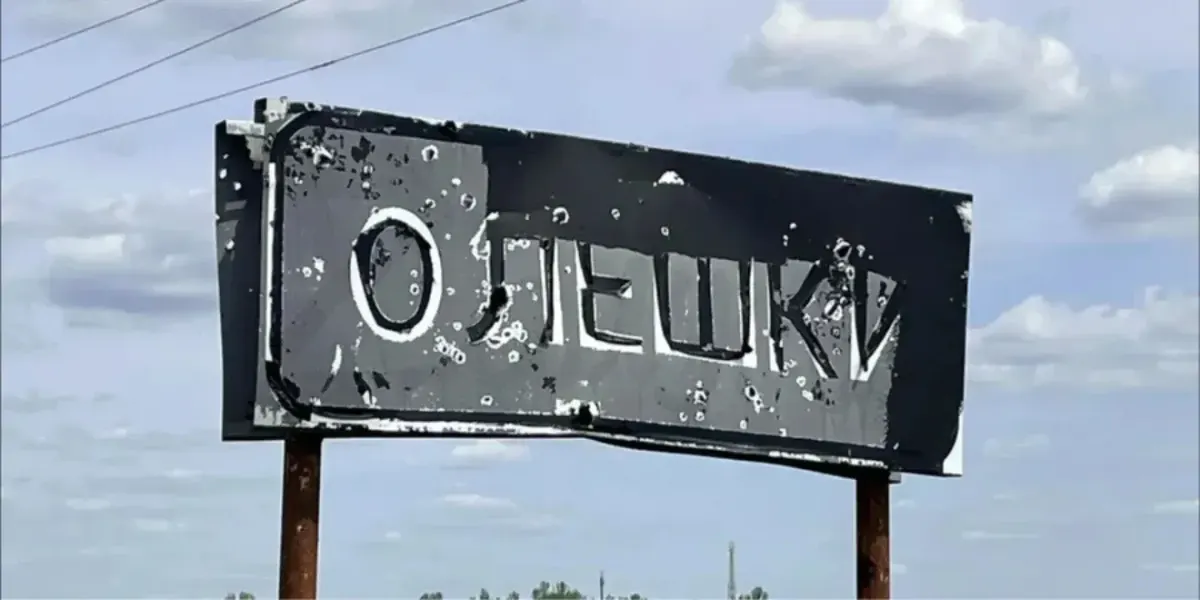
Oleshky, on the left bank of the Dnipro opposite Kherson, was occupied by Russia in the first days of the full-scale invasion. Before 2022, about 24,000 people lived here. By autumn 2026, according to estimates by the Ukrainian authorities and the White House, 1,700–2,000 people remained in the town, including almost 50 children, according to the Kherson Regional Military Administration. Without electricity, gas, water, food or medicine...
BEFORE: BLOCKADE AND HUNGER
In December 2025, the Russian occupiers mined the roads around the town, and regular supplies effectively stopped. According to the town's military administration, the last vehicle carrying food entered on 26 May. On 26 September, Foreign Minister Andrii Sybiha said that, according to available reports, people in Oleshky were surviving by eating “grass and weeds”. Russia never granted the UN humanitarian access to the town.
From March 2026, the Ukrainian military delivered food and medicine across the Dnipro by drone. In one of the largest operations, about 4 tonnes of food were dropped at 100 locations. According to Oleksandr Prokudin, head of the Kherson Regional Military Administration, Russian forces deliberately shot down these drones and took the food for themselves. The US-based Institute for the Study of War (ISW) also reported on this.
On 26 September, Foreign Minister Andrii Sybiha said that, according to available reports, people in Oleshky were surviving by eating “grass and weeds”. Russia never granted the UN humanitarian access to the town.
At the same time, Moscow blamed Ukraine itself for the blockade. Ukraine's Center for Countering Disinformation recorded that the Russian Foreign Ministry and the occupation administration were spreading claims about a “blockade of the town by Ukrainian drones” and the “mining of roads”. Yet it is precisely from the occupied left bank, including from Oleshky, that Russian drones have been hunting civilians in Kherson since 2024. Locals call it a “human safari”, and in May 2025 a UN commission found that these attacks amount to crimes against humanity.

DURING: THE HUMANITARIAN MISSION
On 23 October, the White House announced that First Lady Melania Trump had helped secure an agreement on a local ceasefire. The Vatican also credits Pope Leo XIV, who on 16 October urged Putin to agree to a truce. The “silence regime” lasted from 03:00 on 27 October to 22:59 on 1 November.
On 30 October, a Ukrainian delegation led by the Verkhovna Rada Commissioner for Human Rights (Ombudsman) Dmytro Lubinets entered the town. Twenty-five buses with 750 seats were prepared for the evacuation. People were taken through occupied Crimea to Anapa, then flown to Belarus, and on 31 October they crossed the border into Chernihiv region. The shortest route, across the Dnipro to Kherson, was never considered: according to Lubinets, it is the front line itself, and a crossing would have required demining Ukrainian defensive positions. The route was agreed with the military, the Defence Intelligence (HUR) and the SBU. Those who stayed received food, water, medicine and fuel.
ATTEMPTS AT MANIPULATION
Russian ombudswoman Yana Lantratova, whom the SBU has named a suspect in the illegal removal of children from Kherson in 2022, brought about 50 journalists, mostly from RT, Rossiya, Izvestia, Channel One and Zvezda.
Russia presented itself as the rescuer. Russian TV channels, including Yevgeny Popov's Rossiya-1, showed collaborator Volodymyr Kharlan as a witness – a “Hero of Russia” whom a Ukrainian court sentenced in absentia to 12 years for collaboration.
Z-blogger Vladimir Romanov wrote that 17 buses had left for Ukraine and 4 for Russia, but that “Russian TV will show more of ‘our’ buses with curtained windows”. Petro Andriushchenko, head of Ukraine's Center for the Study of Occupation, confirms that people were persuaded to register for departure to Russia or not to leave at all, being frightened with “filtration”.
JOURNALISM, NOT PR
According to Newsmax reporter Shelby Wilder, her channel was the only American outlet on the ground. On 30 October, she warned viewers live on air that Moscow wanted to present itself as the saviour of the residents of a town it had itself occupied, that it is Russia that controls what journalists get to see, and that the people they manage to speak to may be under pressure.

HOW RUSSIA USED THE CEASEFIRE
Britain's Sky News gained access to the drone control centre of the 34th Marine Brigade of the Armed Forces of Ukraine and showed how, during the “silence”, Russian armour and infantry moved into the town, while occupation troops carrying large backpacks set themselves up in buildings with basements. Even before the evacuation, Russian soldiers were removing from the hospital morgue bodies that had not been allowed to be buried – more than 30, according to the channel's sources. The brigade commander said that previously the Russians had hardly moved around the town in daylight, but in these days they rotated troops and restored their artillery. Ukraine's General Staff confirmed the rotation, the reinforcement of positions, stronger anti-drone protection along the roads and deliveries of ammunition. Lubinets explained that some of the vehicles were used for demining.
The Kremlin did not deny the accusations. As AFP reported, citing a Ukrainian official, Russia refused to extend the ceasefire.
HOW MANY PEOPLE REMAIN
Melania Trump reported that almost 800 people had been evacuated. How many of them went to Ukraine and how many to Russia has not been officially disclosed. Lubinets attributed this to the agreements with the Russian side.
Not everyone was able to leave. Residents of nearby villages, including Pidlisne and Solontsi, registered for the evacuation but could not reach Oleshky because the roads were mined. Lubinets insists that everyone who wanted to leave the town itself did so, but how many people remain there is “impossible to verify”. According to preliminary data from the Kherson Regional Military Administration, more than a thousand people are still there. The sides are discussing aid deliveries at least once a month.