
History
The Identity of the Donetsk and Luhansk Regions: Why the Donbas Has Not “Always Been Russian”

Writing for the Demokracija: Iryna Sieidkhanova, a Ukrainian journalist and columnist:
My mother and her family are from the Donetsk region of Ukraine. And although I was born in Moscow by chance, I grew up here — in a region that is all too often described today with a single word: “Russian.” To Russians, this word sounds confident, but this claim does not hold up to factual scrutiny. The Donbas has never been Russian — neither historically, culturally, nor demographically.
Let’s start with a simple fact: Donbas is not an ancient historical “land of the Russian people.” It is an abbreviation for the “Donetsk (coal) Basin,” that is, an economic-geographical concept. The region, in its modern sense, took shape relatively late, primarily in the 19th century, when industry began to develop rapidly there. In reality, the territories of today’s Donetsk and Luhansk regions have since ancient times been part of the steppe borderland that the Cossacks called the Wild Field. As early as the 17th century, the Zaporozhian Cossacks established the Kalmiushka Palanka here — an administrative and military unit of the Zaporozhian Army. Mariupol was founded on the site of the Cossack fortress of Domaha (also known as Kalmiushka Sloboda). And Donetsk grew up on the site of the Cossack settlements of Oleksandrivka and Krutogorivka.

A Multiethnic City
Mariupol, where I spent my teenage years, is a city with an exceptionally diverse — and by no means exclusively Russian — ethnic history. A Greek community emerged here in 1778, when Catherine II resettled Crimean Greeks here. Armenians, Jews, and Cossacks lived alongside them, and later Italians joined as well. It was a multi-ethnic city where different peoples coexisted along the banks of the Kalmius River and on the shores of the Sea of Azov. There is not a shred of anything in this picture that could be described as “traditionally Russian.”
Yuzivka and John Hughes
Donetsk is a story unto itself. The first official name of what would become a major metropolitan area was Yuzivka, named after the Welsh engineer John Hughes, who founded a metallurgical plant and a coal mine in the Kalmius River valley in 1869. Along with him, more than a hundred steelworkers and miners from South Wales arrived on eight ships. Welsh immigrants continued to arrive in Yuzivka right up until the Bolshevik Revolution of 1917. The industrialization of the Donbas in the late 19th and early 20th centuries took place with the participation of the British, Belgians, French, and Poles. The city, which Russia today considers its own, was founded by a Welshman on Cossack land. Russia is not part of this equation. These were sparsely populated steppe regions where the influences of various countries and forces converged. The Cossacks, affiliated with the Zaporizhian Sich, played an important role here. It was they who conquered these lands. There was simply no stable Russian majority here.

Under the Russian Empire
At the end of the 18th century, these territories became part of the Russian Empire. But political affiliation does not imply ethnic unity. The empire settled the region with people of various origins — Ukrainians, Russians, Greeks, Germans, and Serbs. From the very beginning, the Donbas took shape as a multinational region.
As already mentioned, the industrialization of the Donbas was largely based on imported Western technologies and expertise. This was not an isolated “internal” development, but part of a broader European economic process. From the very beginning, the South was a multicultural environment where the region’s new industrial identity took shape. It was precisely industrial development in the 19th century that transformed the region into one of the key industrial centers. Workers from various parts of the empire flocked here. In this environment, the Russian language became the language of production and urban life, not as a symbol of the ethnic majority, but as a tool for communication. The census conducted by the Russian Empire in 1897 reveals a complex picture: the rural areas were dominated by a Ukrainian-speaking population, while the cities were more Russified. This is a typical consequence of industrialization, not evidence of the region’s “Russian character.”
Where did so many Russian speakers come from?
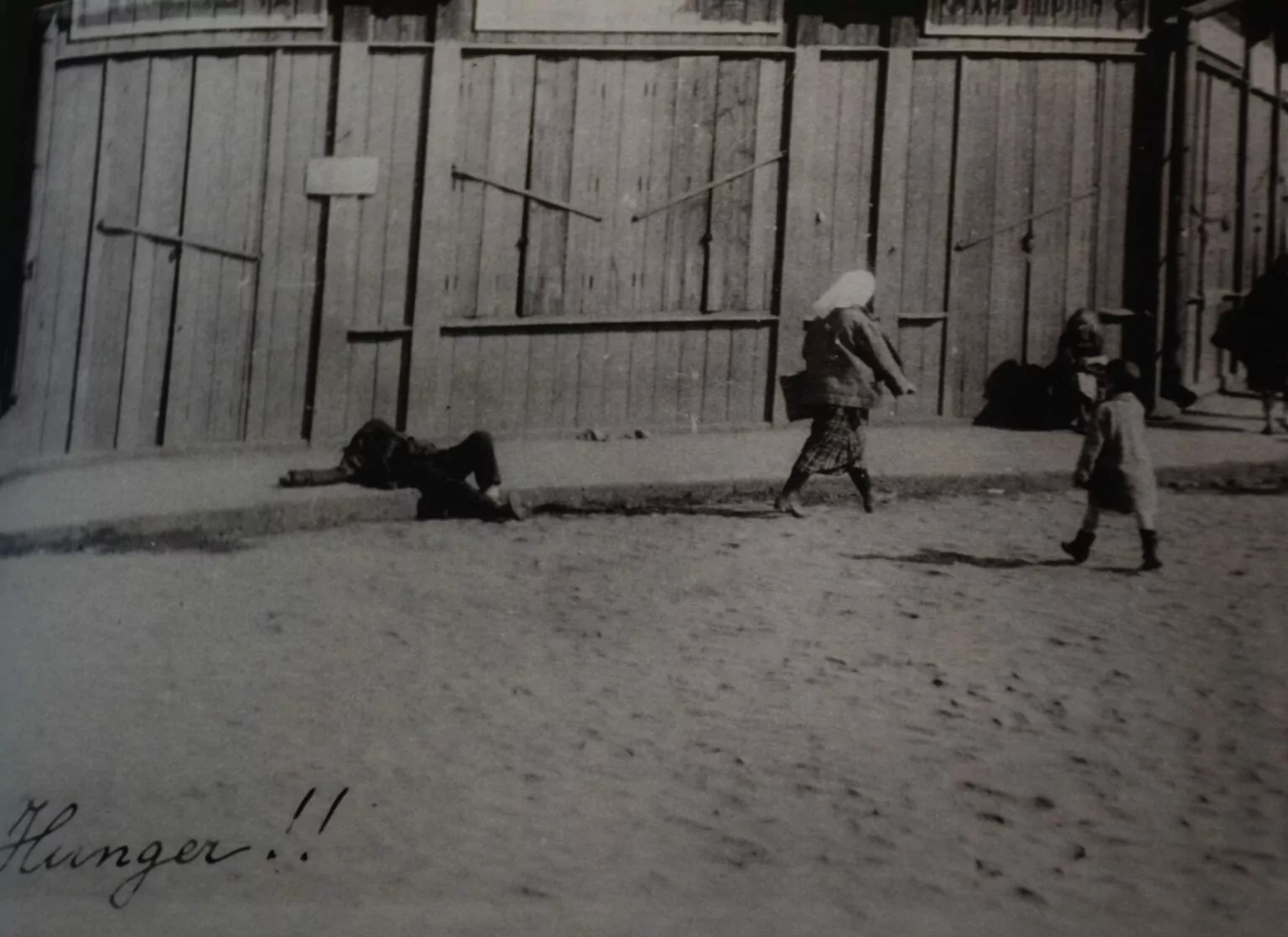
But if the Donbas wasn’t “Russian” from the very beginning, why are there so many Russian speakers there? The answer to this question lies in one of the most difficult chapters of Ukraine’s modern history: the period of 1932–1933. The Holodomor. Stalin’s regime caused an artificial mass famine on Ukrainian territory: it confiscated grain, closed the borders, and placed entire villages on “blacklists”; people died without even having the right to leave their homes and seek food. According to various estimates, nearly four million Ukrainians died—and these are only the direct victims, not counting the demographic losses in the following decades. The Donetsk and Luhansk regions were among the areas hardest hit.
Kolkhoz Workers from Russia
Then, on October 25, 1933, the Council of People’s Commissars of the USSR adopted a secret resolution “on the resettlement of 21,000 kolkhoz families to Ukraine.” 15.5 million rubles were allocated for the resettlement. More than 300 train cars carrying people from Russia arrived in the Donbas. These new residents had neither Ukrainian roots nor ties to this land. They had only Soviet patriotism. Thus, the Holodomor was not the only instrument used to alter the ethnic composition of the Donbas. Before and after it came the repression of the 1930s; the “stifled renaissance,” and deportations to Siberia of all those whom the Soviet authorities deemed “unreliable” — that is, teachers, priests, cultural workers, and simply wealthy landowners. Those who could have preserved and passed on national identity to future generations were destroyed or exiled. They were replaced by people with no ties to this land, speaking a different language and possessing a different collective memory.
Decades of Soviet Russification
This was followed by decades of Soviet Russification: schools where instruction was conducted exclusively in Russian; companies with documentation in Russian; mass culture in which the Ukrainian language was portrayed as “peasant-like” and “outdated.” By the end of the 20th century, the Russian language did indeed dominate the region, but this was neither a natural process nor an expression of the “Russian soul” of the Donbas. It was the result of genocide and a systematic policy of assimilation that spanned several generations.
Mariupol Under the Russian Boot
Now take a look at what is happening today in my city of Mariupol. Before the Russian invasion on February 24, 2022, nearly half a million people lived in the city. During three months of the Russian blockade and bombardment, at least 22,000 civilians were killed — and that is only a very conservative estimate. The rest fled or were deported. According to data from Peter Andruschenko, an advisor to the legitimate mayor of Mariupol, about 80,000 locals remain in the city, mostly retirees. Meanwhile, 59,000 civilian migrants from Russia and Central Asia have arrived in the city—a classic Russian modus operandi: “We kill or drive out the indigenous population and bring in our own.” After one generation, we declare that it has “always been Russian.” The same thing happened with the Crimean Tatars after their deportation in 1944. The same thing happened in the Donetsk region after the Holodomor. And the same thing is happening now in Mariupol and other occupied Ukrainian territories.
Donbas in Independent Ukraine: A Development Often Overlooked
After 1991, the Donbas became part of independent Ukraine within internationally recognized borders, which are also recognized by the UN. It was precisely during this period that the region not only preserved its industrial potential but also experienced significant economic development. Until 2014, Donetsk was one of the wealthiest and most dynamic cities in Ukraine. It was home to large industrial enterprises and financial institutions, and its infrastructure was also developing. Modern stadiums, roads, an airport, and business centers were built in Donetsk. Hosting the 2012 European Football Championship became a symbol of this development: Donetsk presented itself as a modern European city. It is important to emphasize that this development took place within the framework of the Ukrainian state and its economic system, with the participation of the Ukrainian budget, businesses, and international investments. The Donbas did not exist as a separate economic unit “maintained” by Russia, as Russian propaganda portrays it.

The Donbas was not dependent on Russia
The myth that “Russia was responsible for all of Donbas’s development” does not correspond to the facts. The foundations of industry were laid as early as the imperial era through the adoption of Western technologies. During the Soviet era, the Donbas was part of the all-Union economy, just like other regions. After 1991, however, the region’s development took place within the framework of the independent state of Ukraine. Furthermore, the Donbas’s economic ties were not directed solely toward Russia but also toward other markets. Ukrainian metallurgical companies exported products to Europe, Asia, and other parts of the world. This confirms once again that the Donbas was integrated into the global economy and was not dependent on Russia.
The “People of Donbas” Is a Myth Created in Moscow
One of the key elements of Russian propaganda is the concept of the “distinctive people of Donbas” as a supposedly separate community with its own identity, striving for self-determination. This is an appealing but entirely fabricated construct.
From an anthropological, cultural, and international legal perspective, the “people of Donbas” do not exist. The Donetsk and Luhansk regions were home to Ukrainians, Greeks, Jews, Bulgarians, Russians, and representatives of many other nationalities, just as in most regions of Ukraine. The fact that they live in the same region and use a common everyday language does not create a new subject of international law. I myself am a good example: I spent my teenage years in Mariupol, completed my studies in Donetsk, and spoke mainly Russian in everyday life, even though I was also fluent in Ukrainian. At the same time, I am Ukrainian; I have a Ukrainian passport and a clear sense of belonging to Ukraine. Millions of people around me lived the same way. Speaking Russian is not the same as having a “Russian identity,” and this distinction is crucial. This is precisely what Russia deliberately obscures in its propaganda, when it confuses the language of everyday communication with political identity. Let me illustrate this with another personal example: because I am married to a Serbian man, I have spoken mostly Serbian in my daily life for the past 15 years, but that has not made me (and never will) a Serbian woman.
To Whom Does the Right to Self-Determination Apply?
In international law, the right to self-determination applies to colonial peoples who have been systematically oppressed. However, it does not grant any regional group (not even a majority) the right to secede from a country, especially not if this “desire” is organized and armed by a neighboring country. Otherwise, it would be possible to dismantle and divide any country in the world by bringing in one’s own citizens and holding a “referendum” at gunpoint, as happened in Crimea.
In a scientific sense, a “nation” is not merely the population of a given territory. It is a community with a historical identity, culture, and often a language as well. In the Donbas, there is no distinct language or culture that would form an independent “Donbas nation.” The Donbas is part of Ukrainian society with all its diversity.
Separatism with External Intervention
At the same time, the right to self-determination, which is often discussed, does not imply an automatic right to secession. In accordance with UN principles, it must be exercised without violating the territorial integrity of states. The so-called Donetsk People’s Republic (DPR) and Luhansk People’s Republic (LPR) have not been recognized as states by the international community. They are considered part of Ukraine’s territory. Furthermore, OSCE reports have documented the decisive influence of external factors on the development of the conflict. Therefore, it is difficult to characterize the events after 2014 as self-determination. It is much more accurate to speak of separatism in connection with external intervention that uses historical arguments as a tool.
2014: Not a “Civil War,” but an Operation by Russian Special Services
One of the most dangerous Russian narratives in discussions about the Donbas is the phrase “civil war in eastern Ukraine.” It has been used by some international media outlets and certain politicians. This term is a lie. On the night of April 11–12, 2014, a group of 52 armed men crossed the Ukrainian border from Russia. It was led by Igor Girkin (alias Strelkov), a retired colonel of the Russian FSB, a Russian citizen, and a veteran of the conflicts in Transnistria, Bosnia, and Chechnya. On April 13, his group carried out an armed attack on Ukrainian SBU officers near Sloviansk, in which one was killed and three were wounded. Girkin seized administrative buildings and, on behalf of the “Donbas fighters,” proclaimed the establishment of the “DLR.” This was not a spontaneous popular uprising. It was an armed operation carried out by foreign — Russian — intelligence services. Girkin himself has publicly confirmed this on several occasions: “I pulled the trigger on the war.” A man from Moscow, an FSB officer, brought in an armed unit and “triggered” the conflict, which was then presented to the world as an “expression of the will of the local population.”
Evidence of Russia’s Involvement
It is true that in the spring of 2014, there was a mood of protest in some cities in the Donbas. After the Maidan and the change of power in Kyiv, some people felt uncertain. But there is a chasm between social discontent and an armed takeover—a chasm that was bridged by specific people with specific automatic rifles who came from a specific country — Russia.
Evidence of Russia’s involvement has been documented and verified: intercepted conversations, the confirmed presence of Russian professional soldiers who were officially “on leave,” and the supply of heavy weapons across an open border. The climax came on July 17, 2014, when a Boeing passenger plane on flight MH17, en route from Amsterdam to Kuala Lumpur, was shot down over the Donbas. A total of 298 people died, not a single one of whom was a soldier. The District Court in The Hague concluded that the “Buk” anti-aircraft missile system had been delivered from a Russian military unit in Kursk to the Donetsk region. Girkin was sentenced in absentia to life in prison. And to call all of this a “civil war” is to be complicit in the lie.
The answer lies in logic
Donbas is not “a single identity” nor “a single history.” It is a border region shaped by the movement of people, industrialization, and intercultural cooperation. And that is precisely why the claim that it has “always been Russian in nature” does not correspond to the facts. Perhaps some Slovenian readers are thinking: why bother with a distant war? What do I have to do with Mariupol and Donetsk?
The answer lies in logic, not geography. The logic Russia applies to the Donbas is a universal tool: “People who speak our language live here, so this is our land.” And: “This has always been our land, so borders can be changed.” If this logic becomes an accepted norm, every country with national minorities will be a potential target for a similar scenario. If “protecting one’s own” is sufficient grounds for an armed military invasion, then the international security system established after 1945 and cemented in the 1975 Helsinki Accords will simply vanish. This is not an abstraction. It is a real threat that Ukraine is holding at bay at the cost of thousands of human lives.